


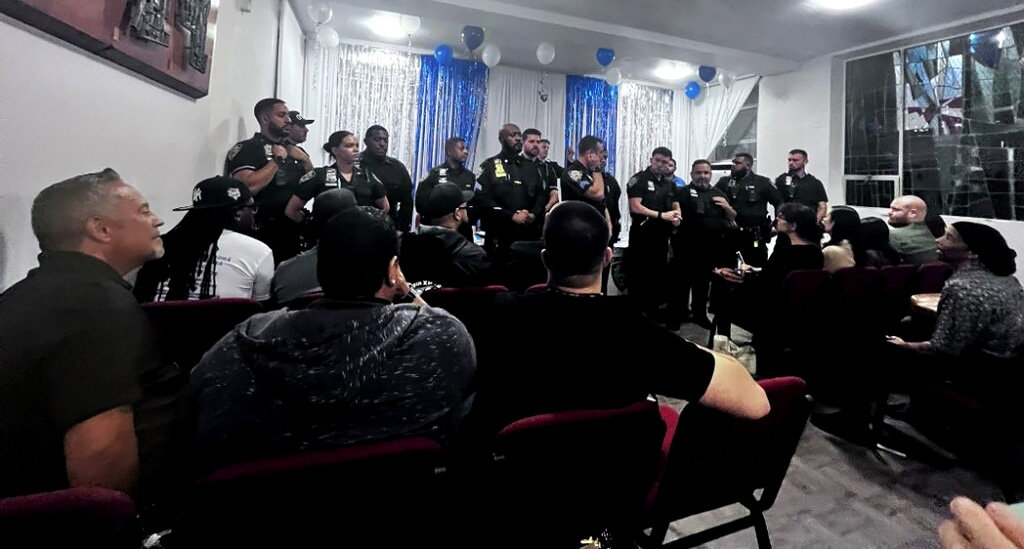
The family of the Angel Mendoza and members of the community listen as officers from the 52nd Precinct speak at a community meeting at St Brendan’s Convent in the Bronx in September. (Frances Colon)
By Frances Colon
On September 25, St. Brendan’s Convent in the Bronx felt more like the heartbeat of the community than a meeting room.
The atmosphere was electric. Every seat was filled, and every eye was focused forward. Latecomers and a few officers lined the back wall shoulder to shoulder as the rain tapped softly against the windows.
Police officers from the 52nd Precinct, community leaders, residents, and the family of Angel Mendoza were gathered for a serious conversation about the safety of Williamsbridge Oval Park after the stabbing death of 14-year-old Angel on August 5. The room was tense as attendees waited for the meeting to begin.
The rules were set and clear: no cameras, no recording, and respect for one another. “We know these topics are emotionally charged but let’s show each other respect” said Brenda Caldwell, president of the 52nd Precinct Community Council.
Deputy Inspector Chase A. Maneri, commanding officer of the 52nd Precinct, said that the Williamsbridge Oval Park is challenging to monitor due to its numerous ungated entrances and limited camera access.
A resident who runs in Oval Park daily asked what the NYPD planned to do to increase safety. Maneri outlined the department’s strategy. The first step, he said, was to increase the number of cameras. “As of right now, the Oval Park does not have cameras inside the park,” he said. “There are cameras located outside the park, but they are from a distance…What we are looking to do is get some funds from elected officials for ARGUS cameras.”
Maneri said ARGUS cameras can be remotely controlled from the precinct. “We want to put them on top of the community center and on top of a couple of light poles in the park,” he said. One issue is that ARGUS cameras need 24-hour power to run, which the solar-powered light poles in the park cannot supply. The precinct did receive funding to install two cameras on top of the community center that will have pan, zoom, and 360-degree viewing capabilities. However, unlike the ARGUS cameras, the feed of this footage would be sent to a third party source rather than the precinct. Police would need a warrant to retrieve the recording, said Maneri. Another strategy is to increase patrols in the Williamsbridge Oval Park, he said.
Some voice their frustrations about the lack of prevention. “The so-called village to raise a child did not interfere and realize what was escalating,” Sirio Guerino said. “Until we get tough on crime and start enforcing laws on the books and make the penalties stick, it’s never going to change.”
Public safety requires consistent police presence, not just promises, said the group, and better coordination in the response with community leaders. The lack of communication on plans to install cameras added to the frustration in the room. New York City Council member Eric Dinowitz got funding for 20 cameras for the Oval Park which are supposed to be installed by early October. But they are not ARGUS cameras and the feed goes through a third party and not the 52nd Precinct.
The night wasn’t without moments of unity. The family of Angel Mendoza sat quietly near the front, joined by neighbors who came to show support. The officer who apprehended Mendoza’s attacker was honored that night.
By the end of the meeting, residents’ reactions were mixed. Some complimented the 52nd Precinct. “I want to say, really, thank you to the 52 for being a partner with us in our community,” said one woman.
Another local resident told the police. “People are complaining about you, but thank you because you all run to the trouble that we run from.”
The grief was palpable, but the meeting closed with a shared understanding that safety at the Oval will require everyone — police, politicians, and neighbors — to show up and take responsibility. It painted a complicated picture of the Bronx, a community tired of loss, frustrated by politics, and yet unwilling to give up. Enforcement and technology may help, but residents also emphasized the importance of community involvement. “We need action, and we need it now,” said one.
In the North Bronx, that call was more than a demand. It reflected a community determined to prevent another tragedy.