


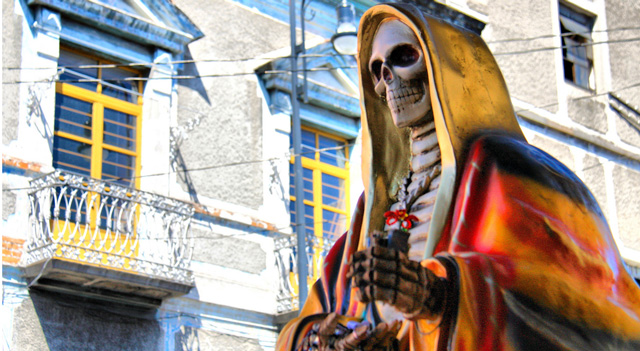
(Christine Zenino)
By Jessica Torres
The Bronx Journal Staff Reporter
There are those who believe in good and those who believe in evil.
In religions such as Catholicism, where there is a God and a Devil, good and evil exist. The primary religion in Mexico is Catholicism, like in many Spanish-speaking countries, yet, there are some Mexicans who believe that there is a “saint” outside that faith that is more receptive to their prayers.
She cares for them without discriminating by profession, social class, or sexual orientation. She will aid them in their times of need. She is the “Santa Muerte” translated in English as the “Holy Death” or “Saint Death.”
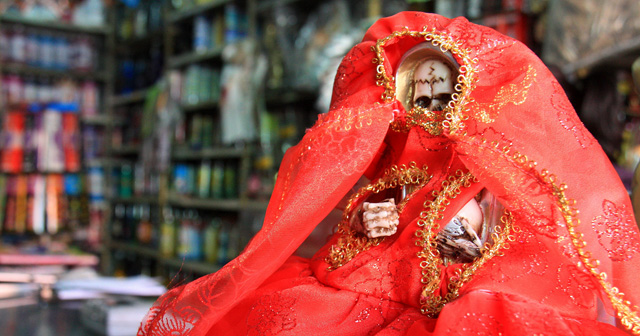
Santa Muerte, as the name suggests, looks much like the grim reaper. She is a skeleton, draped in a tunic, that carries various objects and each symbolizes what she can offer to those who request help: a scythe, a world, a scale, an hourglass, an owl, and a lamp.
Today’s Santa Muerte worshipers are not just found in Mexico. Martin Gonzales is a 25-year-old Mexican bartender who lives in New York. Gonzales is someone who believes his life has been “protected” by the Santa Muerte. He first heard of her when he enrolled in the Mexican Army and his friend gave him an amulet. “It is said that when you’re given a pendant of the Santa Muerte, it is good luck,” says Gonzales.
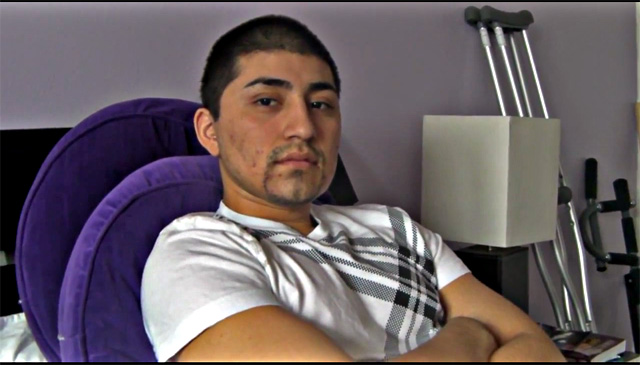
Martin Gonzales
Amulets, candles, books, pocket images and religious objects are sold in stores called botanicas. Fermin Perez Romero is a 42-year-old botanica owner. He sells statuary of saints and icons. He is familiar with Santa Muerte and her followers. “What I know about Santa Muerte is that she has been created by God, ” Perez says. “Her job is to guide us towards God on the last day of our existence.”
Santa Muerte is often assumed to be an evil entity, says Perez, but Santa Muerte is a servant for those who need her. “People ask her for good things, as well as for bad things,” Perez says. “It depends on the person and not on Santa Muerte.”
“Believers come not only from Mexico,” he says, “there are a lot of Dominicans and a few Puerto Ricans that are taking her into consideration. They ask for protection and other favors.” Followers of Santa Muerte usually identify themselves as Catholics and believe that Santa Muerte is just another saint they can rely on, he says. “Some people believe in both,” Perez says. “They have La Virgen de Guadalupe and Santa Muerte. Yet, those who know a little about Santa Muerte know to never place them in the same altar. She (Santa Muerte) is very jealous, she doesn’t like to share her altar with other saints.”
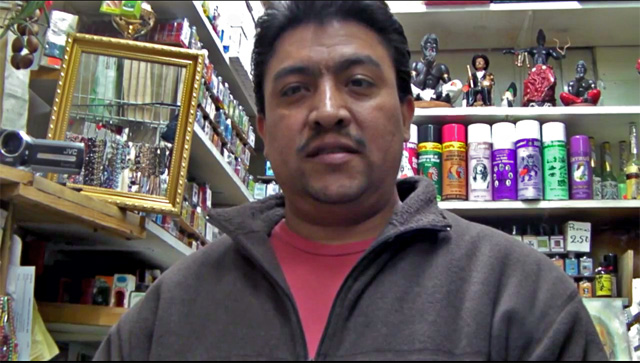
Fermin Perez Romero
The interest in Santa Muerte has grown in the past five to six years. There have been various books, films and articles that document the history of the saint, also known as Señora de Sombras (Lady of Shadows), Señora Blanca (The White Lady), and La Flaca (the Skinny Lady), among other names.
“El Libro de la Santa Muerte” (The Book of the Saint Death) by Oriana Velasquez offers guidance for those who desire to worship her. It describes the origin of the cult, the purpose of the objects she carries, along with prayers and rituals followers can perform.
According to Velasquez’s book, the saint appeared in the early 18th century, but did not become popular until 1965, first in Hidalgo, Mexico, and later in cities such as Guerrero, Veracruz, Tamaulipas, Campeche, Morelos, Nuevo Leon, Chihuahua and Mexico City, where the cult grew. The first chapel of Santa Muerte was built in the Mexico City neighborhood of Tepito, today known for its very open worship of the saint.
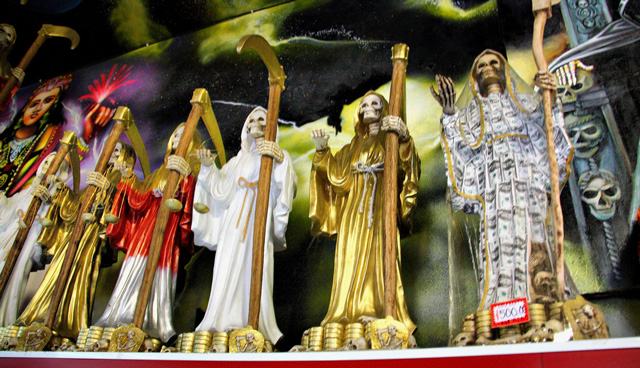
(Christine Zenino)
Martin Gonzales believes that Santa Muerte has safeguarded his life at least once when he was in the Army and out with friends. “It was late,” he says. “We were walking and someone else we knew walked behind us. There were two roads, one with light and one dark. I told them that we had to go through the other side (dark) and that I had a strange feeling. But they didn’t believe me. I forced them to go to the other pathway. The guy who walked behind us went through the lighted pathway. As the roads continued, they reunited. When we looked back, we saw two men running and the guy who walked behind us was on the floor dead. They had just robbed him,” says Gonzales. “Whenever I had a bad feeling I would feel something in my chest where the pendant was.”
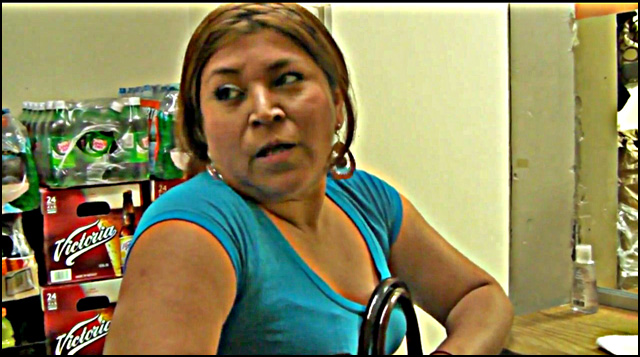
Laura Palomeque
Santa Muerte is known for being accepting and an enforcer of justice. But she is also known to be vengeful. Followers understand this. Laura Palomeque is a housewife who defends Santa Muerte and doesn’t understand the negative connotations surrounding the saint. Palomeque says that people will often pledge offerings to the saint, but won’t deliver and then blame the saint for their misfortunes. “For example, us women, if we like that guy, we ask for a hook up with him and if she helps, we believe in her,” says Palomeque. “Just like with the Virgin (Mary). You will be glad that she helped you get what you asked for.”
The Catholic Church does not believe that Santa Muerte is an actual saint. “Death is not a skeleton,” says Father Antonio Palacios, pastor of the St. Anselm parish in the Bronx. “When the Church speaks about death and of the holy death, it doesn’t speak of it as a Saint Death, but a step. It’s a step forward to the eternal life.”
One of the appeals of Santa Muerte is that she does not judge individuals with alternative lifestyles. This is a point that devotees such as Enriqueta Romero, one of the pioneers and first to have a chapel for Santa Muerte, make in their defense of the saint. “We’re all born with something bad,” Romero says in “El Libro de la Santa Muerte.” That is why people go to Santa Muerte in search of protection and care without any reprehension due to their lifestyle.”
Father Antonio
Father Antonio responds that the Catholic Church is open to all, with some conditions. “Everyone in the Catholic Church is welcomed, but is not welcome to bring something without theological foundation…things that have nothing to do with the church, but diabolic things.”
Father Antonio has little sympathy for Santa Muerte worshipers or their life choices. “They are people who are not the light of the Christian lifestyle, a life of faith,” he says. “They are people who live like animals, taking advantage of everything they can, having no limits, just getting an external happiness, physical, momentarily.”
The Catholic Church doesn’t have a saint dedicated to death. Those who believe in Saint Death, says Antonio, “don’t tend to be people who are cultured or have studied.” He adds, “They are people who utilize it to find hope in their lives because they don’t see any other. It exists for them but it doesn’t exist. Saints are the ones who have lived their faith, people who have been honest, charitable, who have been role models. They lived it and have been made sanctified, being like him, imitating him, with a lot of prayer in service with others, not to others.”
Despite the Catholic Church’s objections, Palomeque, like many other followers, see Sante Muerte as another saint. “Just because she doesn’t have a halo and has no skin on her face, doesn’t mean she’s bad,” says Palomeque.
(Christine Zenino)